



Quick summary
- Beneath the quiet homes and streets of Turkey's Cappadocia region lie narrow corridors leading to a sunless world.
- Carved entirely into rock, this subterranean realm houses rooms, storage facilities, wells, churches, and defensive tunnels stretching dozens of me…
- Behold Derinkuyu, one of the most complex underground cities ever built.
NavigationIn this article
.
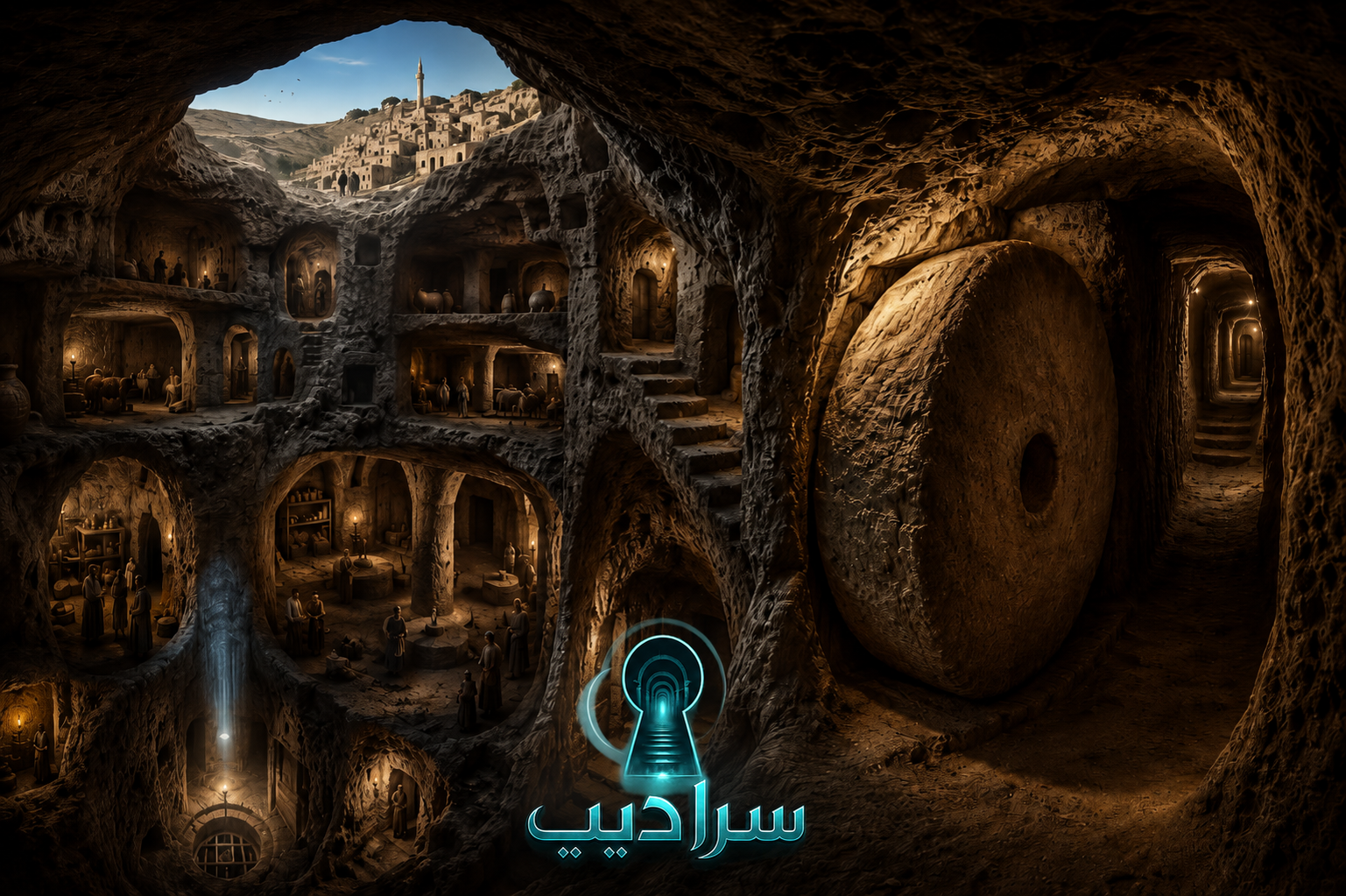
Beneath the quiet houses and streets of Turkey’s Cappadocia region lie narrow corridors leading to a world untouched by sunlight. It is a world carved into the rock, containing rooms, storehouses, wells, churches, and defensive passageways extending dozens of meters deep into the earth.
This is the city of Derinkuyu, one of the most complex underground cities left behind by the ancient inhabitants of Anatolia. It was not merely a collection of caves used for temporary hiding, but a fully integrated settlement designed to allow a large number of people to live underground whenever survival above ground became perilous.
Who built this city? How did its residents manage to breathe and obtain water? And what was the danger that forced them to abandon the daylight and hide in the depths of the earth?
A Complete City Behind a House Wall
The popular story goes that a resident of the town of Derinkuyu was making renovations inside his home during the 1960s when he discovered a strange opening behind one of the walls. The opening was not a small storage room or an abandoned cellar, but an entrance to a vast network of tunnels and rooms carved into the rock.
As exploration work expanded, it became clear that the tunnels did not end after a few meters, but descended into successive levels beneath the ground. In the mid-1960s, a portion of the city was opened to visitors, but the section accessible today represents only a limited fraction of the total area, with parts of it still closed to public exploration. The Turkish Ministry of Culture and Tourism indicates that the depth of Derinkuyu reaches approximately 85 meters, and that only about ten percent of it is open for visits.
However, it is important to note that the city was not entirely absent from the memory of the local inhabitants. Some of its entrances, wells, and rooms were known to the people of the region, while modern excavation and cleaning operations revealed its true scale and transformed it into a globally renowned archaeological site.
Why were the rocks suitable for building an underground city?
Derinkuyu is located in the Cappadocia region of central Turkey, an area whose geological nature was shaped by ancient volcanic activity. Volcanic materials covered vast areas of land and, over time, transformed into layers of relatively soft volcanic rock known as tuff.
These rocks were cohesive enough to preserve the rooms and corridors, yet at the same time they were easily carved using ancient tools. Because of this, the inhabitants of Cappadocia did not settle merely for building their homes above ground; rather, they carved houses, storehouses, churches, and monasteries inside and beneath the mountains.
The Cappadocia region encompasses a large number of underground settlements varying in size, with official Turkish sources estimating their number to be between 150 and 200 underground rock-cut settlements. Derinkuyu is considered one of the most famous, deepest, and most complex of these cities.
Who built the city of Derinkuyu?
There is no definitive answer identifying a single people who built the entire city in a specific period of time. This is because Derinkuyu was likely not excavated in a single phase, but rather expanded and changed at the hands of multiple groups who lived in the region over many centuries.
Some accounts suggest that the roots of settlement in the region may date back to ancient Anatolian civilizations or to the period of the Assyrian colonies. Meanwhile, other sources link the city's major expansion to Christian groups who needed sheltered places during periods of persecution and invasions.
The Turkish Ministry of Culture and Tourism notes that the city was built as a defensive and hiding site during the spread of Christianity, and estimates that its main architectural profile dates back to the ninth and tenth centuries AD. As for UNESCO, it indicates that Christian communities in Cappadocia began using rock-cut dwellings as early as the fourth century, and that underground cities such as Derinkuyu were later used as refuges during the periods of the Arab-Byzantine wars.
The version closest to reality is that the origins of some corridors and rooms are ancient, and that subsequent groups later expanded them, connected them, and added religious and defensive facilities to them. This is why Derinkuyu looks as though it is a city built by successive layers of history, rather than a single civilization alone.
What was life like inside the city?
Upon descending into Derinkuyu, the shape of the place gradually changes. The air grows cooler, the corridors narrow, and the sounds of the outside world vanish. On both sides of the tunnels appear rooms of various sizes, each with a specific function.
The floors close to the surface were often used to shelter animals. Placing the stables on the upper levels was a practical decision, because moving cows, horses, and livestock through narrow tunnels to the deep floors would have been extremely difficult.
On the other levels, there were rooms for storing grain and food, places for making wine and grape molasses, communal kitchens, and dining and meeting halls. The city also includes churches, religious spaces, a missionary school, and places associated with the practice of Christian rituals.
Not every family owned an independent kitchen. It appears from the number of kitchens and the manner of their distribution that some facilities were used collectively, which points to a social system that regulated food, storage, guarding, and the allocation of spaces.
Life inside was undoubtedly difficult. Lighting relied on oil lamps, movement took place through low and narrow corridors, while smoke, humidity, and crowding posed a constant challenge. Nevertheless, the city was not designed to be a comfortable place, but rather a safe place that would keep its inhabitants alive until the danger outside subsided.
How did the residents breathe underground?
One of the most fascinating parts of Derinkuyu is the ventilation network that allowed air to reach the deep levels. The city features vertical shafts connected to rooms and corridors, which helped circulate air and reduce the asphyxiation resulting from the presence of humans, animals, and burning lamps.
The depth of one of the main ventilation shafts reaches about 55 meters, and a part of it was also used as a water well. This design helped the inhabitants obtain water from inside the city without having to go outside or rely entirely on exposed sources that enemies could control or poison.
The existence of these systems does not mean that the residents lived permanently in the deepest parts of the city. Most likely, Derinkuyu was used as a sanctuary during times of danger, while normal life, agriculture, and animal husbandry took place above ground when conditions permitted.
Stone doors that are difficult to breach
The protection of the city did not rely solely on concealing its entrances. Some passageways were equipped with massive circular stone doors, resembling millstones, which could be rolled from the inside to block the path.
When closed, the door transformed the corridor into a barrier that was extremely difficult for attackers to push open from the other side. Some of these doors also featured small apertures that could be used for surveillance or defense.
As for the narrowness of the tunnels and their low ceilings, these were not necessarily the result of poor construction. This design granted the defenders a clear advantage, as attackers were unable to advance in large groups or use their weapons with ease. They had to pass through single file in corridors well-known to the locals, while remaining completely unaware of what awaited them on the opposite side.
Official sources confirm the presence of large cylindrical stones at the entrances of some tunnels, which were used to seal the passageways when facing danger.
How many people lived in Derinkuyu?
Estimates frequently claim that the city was able to accommodate around twenty thousand people along with their animals and provisions. However, this figure is difficult to prove with absolute precision, because a large portion of the city has not been fully studied or opened, and the population fluctuated depending on the duration of the hiding and the surrounding circumstances.
Nevertheless, the design of Derinkuyu confirms that it was prepared to receive a large community, rather than just a single family or a small group. The presence of stables, storerooms, kitchens, wells, churches, and meeting halls points to a meticulous layout that allowed hundreds, or perhaps thousands, of people to survive indoors for a period of time.
The true value of the city does not lie in population figures alone, but in its ability to provide the basic elements of survival within a closed environment: air, water, food, protection, and social organization.
Was Derinkuyu connected to other cities?
There are accounts that speak of a long tunnel connecting Derinkuyu to the nearby underground city of Kaymakli, located several kilometers away. Although extended tunnels have been discovered in the region, the idea of a fully passable route between the two cities still awaits clear and comprehensive archaeological proof.
The spread of this narrative is understandable; Cappadocia encompasses a vast network of dwellings, storehouses, churches, and rock-hewn cities. Some structures may have been linked to one another via short or long passages, but that does not necessarily mean there was a single network connecting all the underground cities in the region.
Therefore, one must approach with caution the widely circulated maps and cross-sections that portray Cappadocia as if it were a single, fully interconnected underground kingdom. The discovered reality is astonishing enough, and does not need the addition of details that have not yet been proven.
A city for protection, not an unknown civilization
Derinkuyu is surrounded by many theories, among them that it was built to face a global catastrophe or an ancient nuclear war, or that unknown entities contributed to its construction. However, no reliable archaeological evidence supports these ideas.
Building the city did not require supernatural technologies. The rock was workable, and the labor likely continued across generations, with each community adding rooms and corridors to suit its needs.
The true achievement is more fascinating than fantastical theories. People living with simple tools were able to understand the nature of the rock, the movement of air, and water sources, subsequently transforming the subterranean depths into a fully integrated defensive system.
Derinkuyu within Cappadocia’s World Heritage
Göreme National Park and the Rock Sites of Cappadocia were inscribed on the UNESCO World Heritage List in 1985. The registered area includes the underground cities of Kaymakli and Derinkuyu, alongside the churches, settlements, and rock sites scattered throughout the region.
UNESCO does not view these sites merely as strange tunnels, but sees them as part of a vast cultural landscape that reveals humanity's ability to adapt to nature and transform volcanic rock into dwellings, places of worship, and defensive refuges.
The Real Secret of Derinkuyu City
We may never know the name of the person who excavated the first room beneath Derinkuyu, or the moment when the inhabitants decided to turn the small shelter into a multi-tiered city.
But what we do know is that fear was one of the primary architects of this place.
When the roads became unsafe, and when armies and invaders drew close to the villages, the inhabitants were not always able to resist or flee great distances. So, they chose a third way: disappearing beneath the enemy's feet.
Above ground, the village might have appeared deserted, showing no sign of life. Yet below, families gathered inside rooms, guards watched the entrances, animals settled in the stables, air descended through long shafts, and stone doors were sealed while waiting for the danger to pass.
Derinkuyu is not evidence of a supernatural civilization that vanished without a trace, but rather a testament to human resilience. It is a city that was not built to display power or wealth, but to achieve a single purpose that was both exceedingly simple and complex at the same time: survival.
Frequently Asked Questions about the City of Derinkuyu
Where is the city of Derinkuyu located?
It is located in the Nevşehir Province within the Cappadocia region of central Turkey, approximately 30 kilometers from the city of Nevşehir.
What is the depth of the city of Derinkuyu?
It reaches a depth of about 85 meters beneath the earth's surface and consists of multiple levels containing various rooms, tunnels, and facilities.
Why was the underground city built?
It was used as a defensive refuge allowing inhabitants to hide during periods of invasion, persecution, and military turmoil.
Did the residents live there throughout their entire lives?
There is no evidence that all of its residents lived there permanently. Most likely, it was used during times of danger, with some of its rooms utilized for storage and work during normal times.
Can Derinkuyu be visited today?
Yes, specific parts of the city can be visited, but most of its area is not open to the public.
Author: Saradeeb Team
Have a thought or question about this article?
Continue the conversation in the community and share your ideas with readers and writers.

Comments 0
Share your thoughts respectfully. Abusive or disruptive comments may be hidden.